AI Incident Auto-Remediation Platform
Overview
Every production incident starts with an alert. Engineers shouldn’t have to start from scratch.
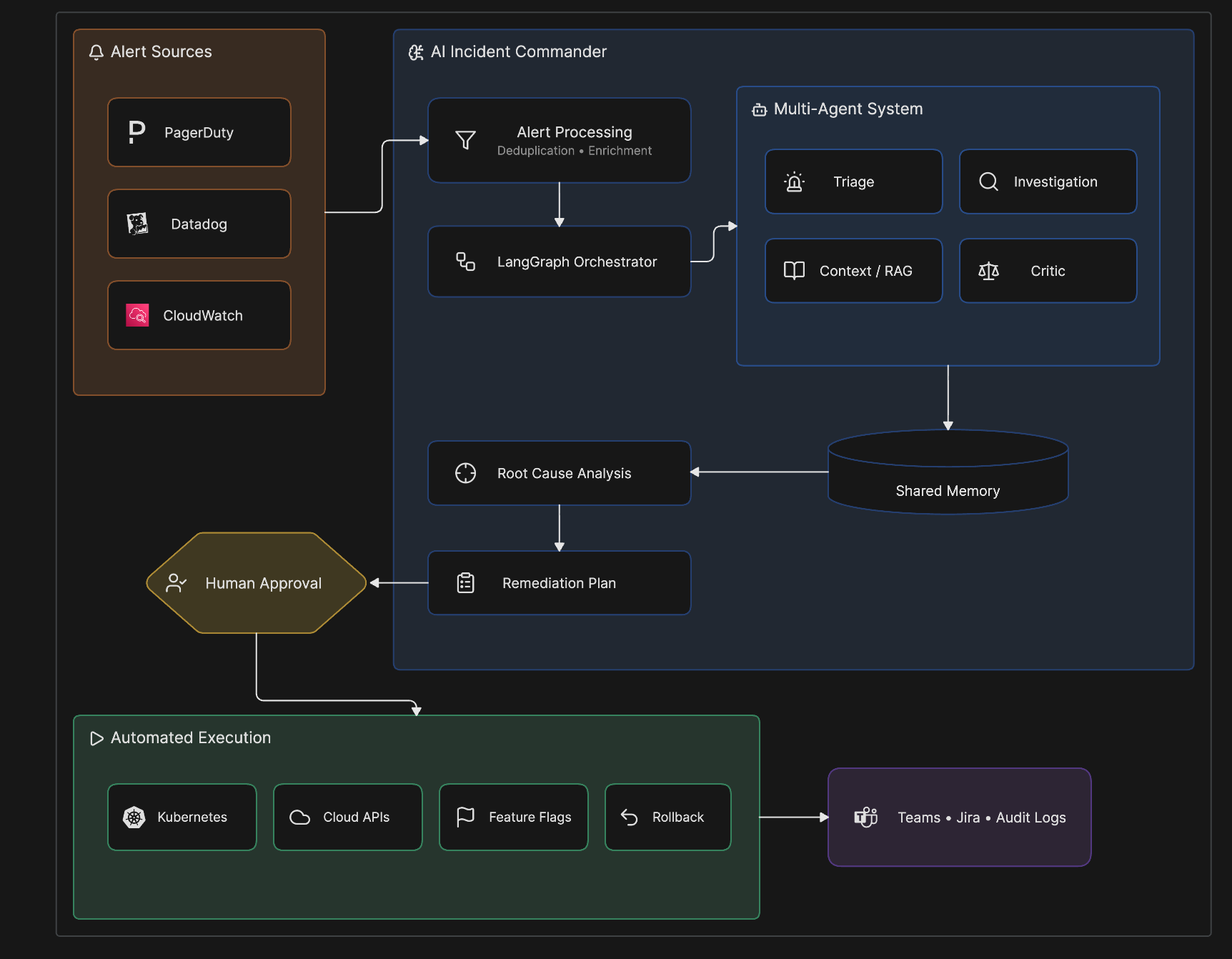
Inspired by large-scale production operations, this platform demonstrates how Agentic AI can automate incident response by ingesting alerts, investigating failures across multiple operational systems, identifying probable root causes, generating explainable remediation plans, and coordinating safe execution through specialized AI agents.
Instead of treating an incident as a single prompt to an LLM, the platform decomposes the investigation into specialized agents that collaborate through an orchestrator, maintain shared memory, validate each other’s reasoning, and continuously build confidence before recommending production actions.
Problem
Modern cloud platforms generate thousands of alerts every day from monitoring systems such as PagerDuty, Datadog, CloudWatch, Kubernetes, and application monitoring tools. Engineers must manually correlate logs, metrics, deployment history, infrastructure state, runbooks, previous incidents, and operational documentation before identifying the actual failure.
This manual investigation leads to:
- Alert fatigue
- Slow incident triage
- Increased Mean Time To Resolution (MTTR)
- Inconsistent debugging approaches
- Repetitive operational work
- Higher production downtime
Solution
Built a production-inspired multi-agent AI incident response platform that transforms raw infrastructure alerts into evidence-backed remediation plans.
The platform automatically:
- Normalizes alerts from multiple monitoring systems
- Deduplicates repeated incidents
- Classifies severity and impacted services
- Retrieves logs, metrics, deployment history, and runbooks
- Performs AI-assisted root cause analysis
- Validates findings using a critic agent
- Generates explainable remediation recommendations
- Supports human approval before executing production changes
- Maintains memory throughout the complete incident lifecycle
Architecture
What I Built
- Built a graph-based multi-agent workflow using LangGraph to orchestrate specialized AI agents throughout the incident lifecycle
- Designed dedicated agents for incident triage, investigation, retrieval, reasoning, validation, and remediation planning
- Implemented Retrieval-Augmented Generation (RAG) over operational runbooks, deployment history, architecture documentation, and historical incidents
- Added Redis-backed alert deduplication to prevent repeated AI processing of duplicate incidents
- Created persistent incident memory using PostgreSQL and Redis, enabling long-running investigations with shared context
- Integrated logs, metrics, deployment history, Kubernetes resources, and operational documentation into a unified investigation pipeline
- Designed a critic agent that validates evidence, challenges reasoning, and reduces hallucinated remediation recommendations
- Added human approval checkpoints before irreversible infrastructure actions while supporting future autonomous remediation
Key Features
- Multi-Agent AI Orchestration
- Automated Incident Triage
- Root Cause Analysis
- Alert Correlation & Deduplication
- Retrieval-Augmented Generation (RAG)
- Persistent Incident Memory
- Critic Agent for AI Validation
- Human-in-the-Loop Safety
- Explainable AI Decisions
- Production Workflow Automation
Key Outcomes
- Demonstrates how multiple specialized AI agents outperform a single monolithic LLM for complex operational workflows
- Reduces manual investigation by automatically correlating operational signals across infrastructure systems
- Produces explainable remediation plans backed by logs, metrics, deployment history, and operational knowledge
- Showcases production-ready AI engineering patterns including orchestration, RAG, shared memory, validation loops, and safe execution workflows
- Provides a scalable foundation for future autonomous incident remediation while maintaining engineers in control of critical production operations